
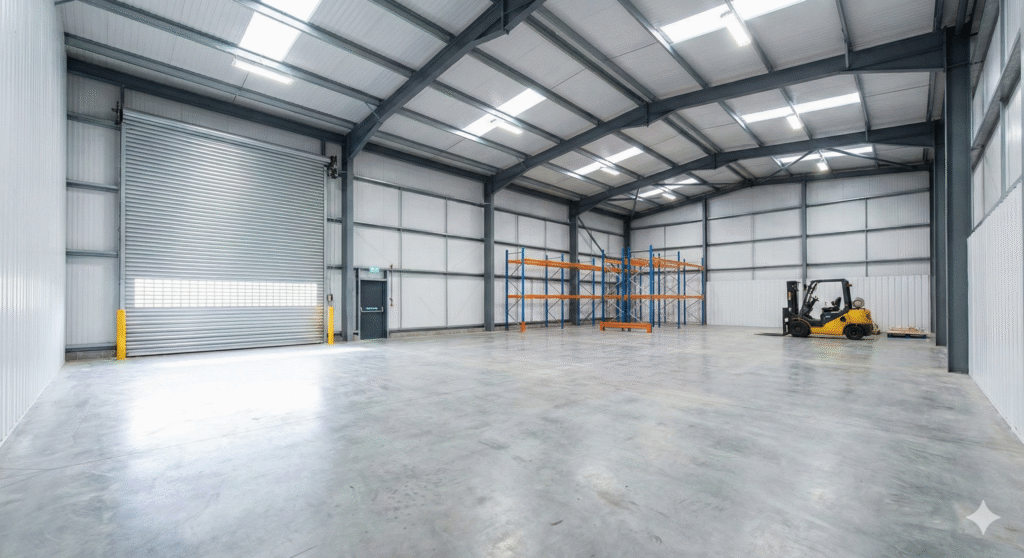
5 Essential Checks Before Renting a Warehouse
Finding the right industrial space is about more than just square footage. When you are renting a warehouse for your logistics, manufacturing, or storage business, the technical specifications of the building can make or break your operation.
A unit might look perfect on paper, but if an articulated lorry can’t turn in the yard or the power supply won’t run your machinery, it’s useless.
If you are searching for industrial units in Leicestershire, Derbyshire, or Nottinghamshire, don’t sign a lease until you have investigated these five critical features.
1. Eaves Height (The Vertical Space)
In warehousing, volume is often more important than floor area. The “eaves height” is the clear height from the floor to the lowest point of the roof structure.
If you plan to install tall pallet racking, a low eaves height will severely limit your storage capacity. A 5,000 sq ft unit with an 8m eaves height offers far more value than the same size unit with only a 4m height. Before renting a warehouse, always measure up to ensure your racking fit-out will work.
2. Loading Bays and Access
How will goods get in and out? You need to consider both the doors and the external yard space.
- Roller Shutters: Are they wide and high enough for your largest items? Are they electric or manual?
- Yard Space: Is there enough room for a 40ft articulated lorry to enter, turn around, and reverse up to the loading bay safely? A cramped yard can cause daily operational nightmares.
3. Power Supply (The Three-Phase Question)
Don’t assume every industrial unit has the power you need. While a small storage depot might run on a standard single-phase supply, most manufacturing or heavy-duty machinery requires three-phase power.
Upgrading a power supply is notoriously expensive and time-consuming involving the distribution network operator (DNO). Always ask the landlord for the current power capacity (in kVA) before renting a warehouse.
4. Floor Loading Capacity
Not all concrete floors are created equal. If you are storing heavy goods or using heavy forklifts, you need to know the floor’s weight-bearing capacity (usually measured in kN/m²). A floor that isn’t built for heavy loads can crack and fail, leading to massive repair bills and operational downtime.
5. Site Security
Industrial estates can be targets for theft. When looking at renting a warehouse, assess the security of the entire site.
- Is the perimeter fenced and gated?
- Is there 24-hour monitored CCTV?
- Is the yard shared with other tenants, or is it private and lockable?
Find Your Perfect Industrial Space with OffiScout
At OffiScout, we understand the technical needs of industrial businesses. From modern distribution centres near the M1 to flexible light industrial units in local business parks, search our listings to find the right base for your operations.