Serviced Office vs. Traditional Lease: The Ultimate Guide for East Midlands Businesses
If you are scouting for a new workspace in Nottingham, Derby, or Leicester, you will face a critical decision before you even view a property: What type of contract should I sign?
Ten years ago, a traditional lease was the only real option. Today, the landscape has changed. With the rise of high-quality flexible workspaces, businesses of all sizes—not just startups—are rethinking the traditional model.
At OffiScout, we help clients navigate both markets every day. Here is the honest comparison of Serviced Offices vs. Traditional Leases to help you decide what’s right for you.
1. The Definitions
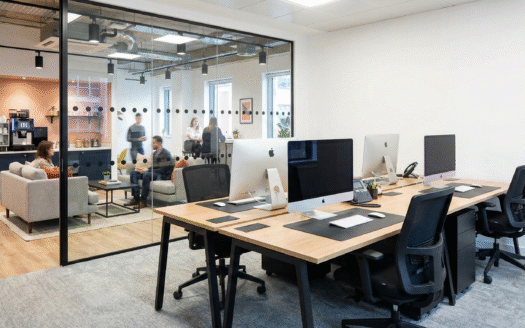
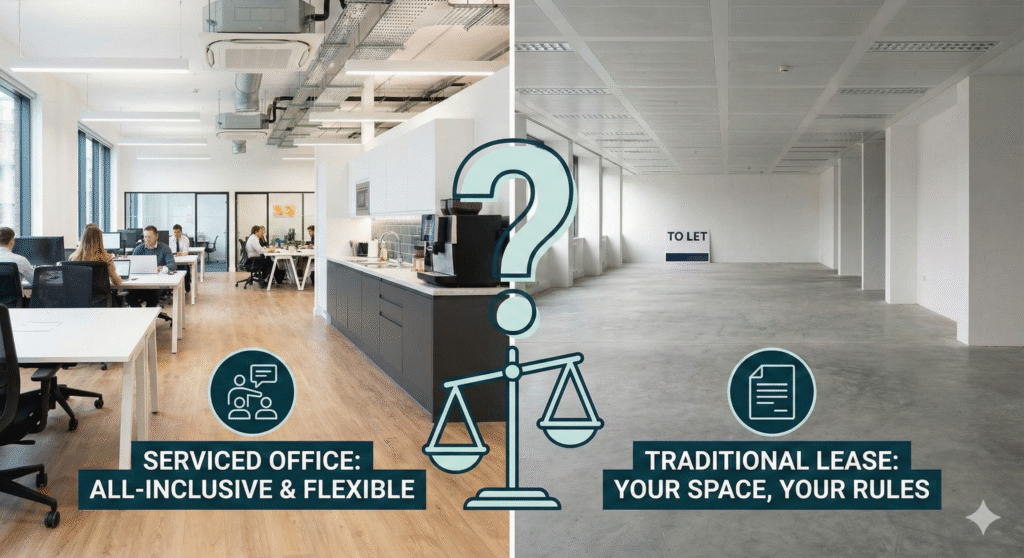
- Serviced Office: A “plug-and-play” solution. You rent a private office within a larger building managed by an operator. The rent is usually “all-inclusive” (rates, bills, furniture, cleaning).
- Traditional Lease: You rent the empty space directly from a landlord. You have full control, but you are also responsible for everything—from fitting it out to buying the toilet roll.
2. Cost Comparison: The “Hidden” Math
On the surface, a Traditional Lease often looks cheaper per square foot. However, this is often a “false economy” for smaller businesses.
| Cost Factor | Serviced Office | Traditional Lease |
| Rent | Higher monthly rate | Lower monthly rate |
| Business Rates | Included | You pay (approx. 50% of rent) |
| Utilities & Wi-Fi | Included | You manage & pay contracts |
| Fit-Out / Furniture | Included (Ready to go) | You pay (£1000s upfront) |
| Cleaning/Maintenance | Included | You manage & pay |
| Dilapidations | None | Cost to restore office upon exit |
The Verdict: If you have under 20 staff, a Serviced Office is usually cheaper when you add up all the total costs of occupation. If you have over 30-40 staff, a Traditional Lease often becomes more cost-effective over a 3+ year term.
3. Flexibility and Speed
- Serviced: You can move in tomorrow. Contracts can be as short as 1 month, though 12 months is standard. If your team grows from 4 to 8 people, you simply move to a bigger room down the hall.
- Traditional: It can take 3-6 months to complete legals and fit-out. Leases are typically 3-5 years minimum. If you outgrow the space in Year 2, you are stuck paying for it until Year 5 (unless you can sub-let).
4. Brand Identity
This is where Traditional Leases win.
- Traditional: It’s your front door, your reception, your signage. You have total creative control to paint the walls pink or install a slide.
- Serviced: You are in someone else’s building. While you can brand your private office, the reception and meeting rooms are shared. It feels like a community rather than “your HQ.”
Summary: Which Should You Choose?
Choose a Serviced Office if:
- You need speed: You need to be operational immediately.
- You are growing fast: You don’t know how much space you’ll need in 12 months.
- You hate admin: You want one simple monthly invoice and no hassle with utility providers.
- Budget: You want to avoid large upfront capital expenditure (CapEx).
Choose a Traditional Lease if:
- You are established: Your headcount is stable and predictable for the next 3-5 years.
- Brand is critical: You need a bespoke HQ that reflects your specific culture.
- Specialized needs: You need specific security, storage, or technical setups that shared buildings can’t provide.
Still Unsure? Scout Both.
The best way to decide is to see the difference yourself. OffiScout can arrange viewings for both high-end serviced offices and prime leased space in the same day.