The True Cost of Renting Office Space: Budgeting Beyond the Rent
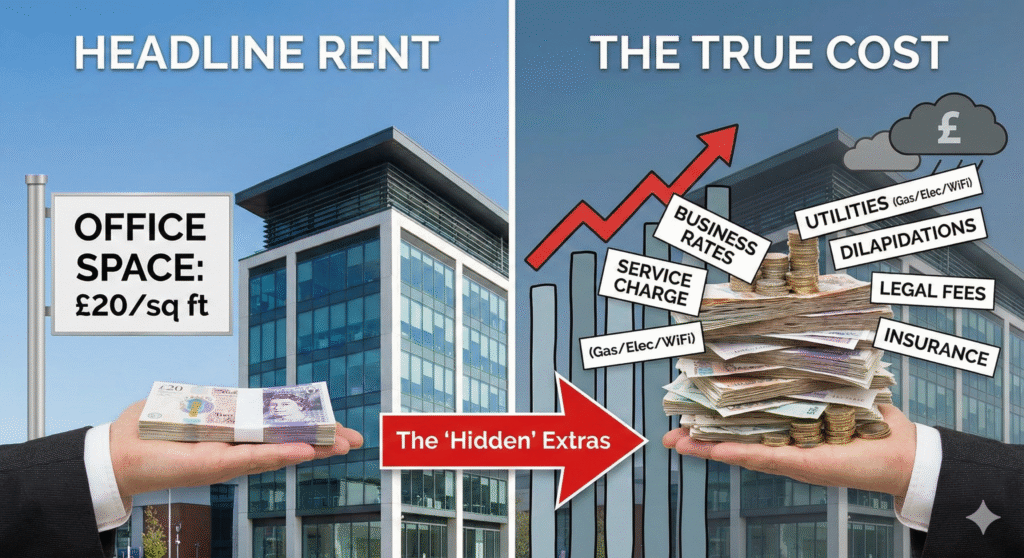
When you are scrolling through listings looking for your next HQ, the headline rent per square foot is usually the first number you see. It’s tempting to take that monthly figure, multiply it by 12, and assume that is your total property budget for the year.
Unfortunately, in the UK commercial property market, the headline rent is just the tip of the iceberg.
Whether you are looking for a retail unit in Derby or a warehouse in Leicestershire, failing to account for the “hidden” extras can blow a massive hole in your cash flow. If you are calculating the cost of renting office space, you need to look at the total cost of occupation, not just the rent.
Here are the top five hidden financial factors you need to budget for.
1. Business Rates
Unlike residential council tax, Business Rates can be surprisingly high—sometimes amounting to 40-50% of your annual rent. This is a tax on non-domestic properties, collected by local councils.
- Leasehold: You are usually responsible for paying these directly to the council.
- Serviced Offices: These are typically included in your monthly licence fee, saving you the hassle of paperwork and variable costs.
Tip: Always check the “Rateable Value” of a property on the government website before signing anything. Small Business Rate Relief may apply if the rateable value is under £15,000.
2. Service Charges
If your office is in a shared building, a business park, or a shopping centre, you will likely have to pay a service charge. This covers the maintenance of communal areas like lifts, receptions, car parks, and landscaping.
The tricky part? In a traditional lease, these costs are often uncapped. If the roof leaks or the lift breaks, your service charge bill could spike unexpectedly. When calculating the cost of renting office space, ask for the service charge history for the last three years to spot any trends.
3. Utilities and Connectivity
In a standard lease, you are responsible for setting up and paying for your own gas, electricity, water, and internet.
Commercial internet installation isn’t like home broadband; getting a leased line installed can take months and cost thousands in setup fees.
- Retail & Industrial: You will almost always manage your own meters.
- Serviced Offices: High-speed Wi-Fi and utilities are “plug-and-play” and included in the price.
4. Dilapidations (The Exit Cost)
This is the sting in the tail that catches many business owners out. “Dilapidations” refers to the legal obligation to return the property to its original condition when your lease ends.
Did you put up partition walls? You have to pay to take them down. Did you install new carpet? You might have to rip it up. The cost of renting office space must include a “sinking fund” to pay for these repairs when you eventually move out.
5. Legal and Agent Fees
Signing a commercial lease is a complex legal event. You will need a solicitor to review the contract, and you may also be liable for the landlord’s legal fees depending on the negotiation.
The Serviced Office Advantage
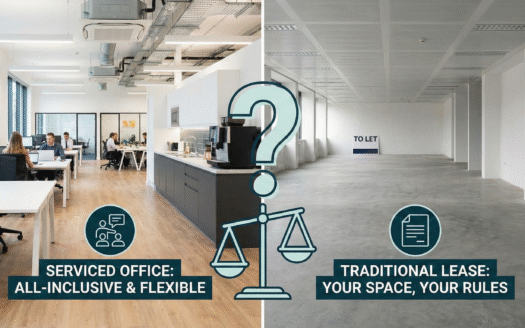
This brings us to why the cost of renting office space in a serviced environment often looks higher on paper but works out cheaper in reality.
With a serviced office or managed workspace, you pay a single monthly fee.
- Rent: Included.
- Business Rates: Included.
- Utilities & Internet: Included.
- Cleaning & Maintenance: Included.
- Furniture: Included.
There are no dilapidations, no surprise service charge spikes, and no legal marathons. You get total budget certainty.
Find the Best Value with OffiScout
Whether you want the all-inclusive simplicity of a serviced office or the long-term stability of a traditional lease, we can help you find a space that fits your budget.
Explore our listings across the East Midlands to compare prices and find the right home for your business.